Load an 80 t boat
Watch the displaced water rise with boat mass while the balanced moving load stays essentially unchanged.
Drawing No. EH–CA–004 // Engineering Case Study
A conventional lock lifts a boat by moving huge volumes of water through a staircase. Falkirk does something stranger: it puts boats into two water-filled gondolas on opposite ends of a giant rotating machine — then relies on a 2,000-year-old principle to keep both sides nearly equal in weight.
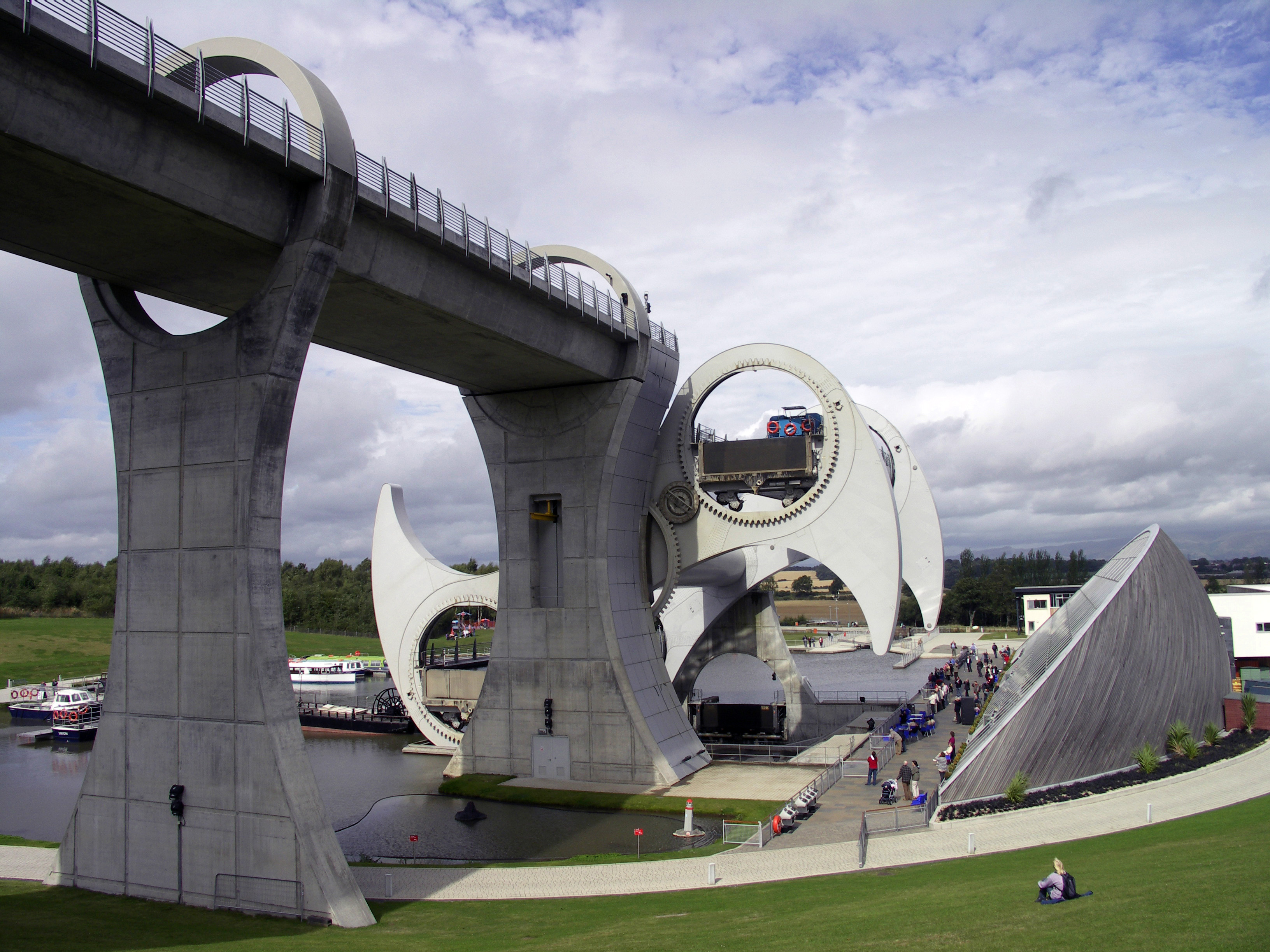
The original connection used 11 locks and could consume much of a day. The Millennium Link instead made the level change itself into a landmark mechanical event.
The project was not just about restoring navigation. The new connection was intended to become a 21st-century landmark and a catalyst for canal regeneration.
Change the boat mass and deliberate imbalance, then rotate the wheel. The animation keeps the gondolas horizontal while the arms turn — the same core kinematic requirement solved by the real synchronous gear system.
The key balance is easier to understand by tracking mass rather than volume. ICE states that each gondola holds 500,000 litres of water; this educational mass accounting therefore uses approximately 500 t of water as its full-water baseline. Note that other published descriptions give about 250,000 litres per gondola, with roughly 500 t being the figure for the pair; the balance argument below is unaffected by which baseline is used, because it depends on displacement rather than on the absolute mass. A floating boat entering at the same water level displaces essentially the same mass of water.
A perfectly balanced wheel still needs power for hydraulic, bearing, seal, gear and control losses. But a mass mismatch adds a direct gravitational penalty proportional to the imbalance.
The wheel arms rotate, but the gondola floors must remain horizontal. The real structure uses a synchronized gear train so each gondola counter-rotates by the same angle that the arms rotate.
Jump back to the simulator and deliberately break the assumptions that make the wheel elegant.
Watch the displaced water rise with boat mass while the balanced moving load stays essentially unchanged.
See how a small mass difference creates direct gravitational torque and extra energy demand.
A deliberately non-physical comparison: add the boat mass without displacement and watch the energy penalty appear.
Return to the intended operating principle and compare the residual energy use with the gravitational work avoided.
The Falkirk Wheel is memorable not because it invented a new law of physics, but because it combined old physics with a completely new infrastructure form.
The descending gondola supplies the counterweight for the ascending one. Archimedes' principle prevents boat mass from destroying that balance.
The project could have hidden its machinery. Instead, the mechanism itself became the visual identity of the canal regeneration scheme.
Steelwork, bearings, hydraulics, watertight interfaces, foundations and control logic all have to work as one coordinated system.
The model intentionally focuses on first-order mass balance, gravitational torque and energy. It does not reproduce the real wheel's detailed bearing friction, hydraulic efficiency, structural flexibility or control system.
For a floating vessel, the buoyant force equals its weight. At a maintained water level, adding a boat therefore causes an approximately equal mass of water to leave the gondola.
This is the reason the wheel can remain balanced even when the two gondolas carry boats of very different sizes.
The simulator uses a representative 12 m wheel radius corresponding to the approximately 24 m vertical lift.
This is the gravitational energy associated with exchanging the positions of unequal masses. Real drive energy also includes hydraulic, frictional, sealing and control losses.
Short answers to the most useful conceptual questions.
Published project facts are separated from the simplified variables used in the interactive model.
Include the inputs and assumptions used.