Skip to content

Drawing No. EH–TH–012 // Thermal Engineering & HVAC

Dry Cooling Tower (Air-Cooled Condenser)

Reviewed August 2026

Finned tube bundles reject heat straight to ambient air with no evaporation and no water contact at all — the only configuration that uses zero water, at the cost of far more surface area and fan power.

No waterNo plumeSensible heat only
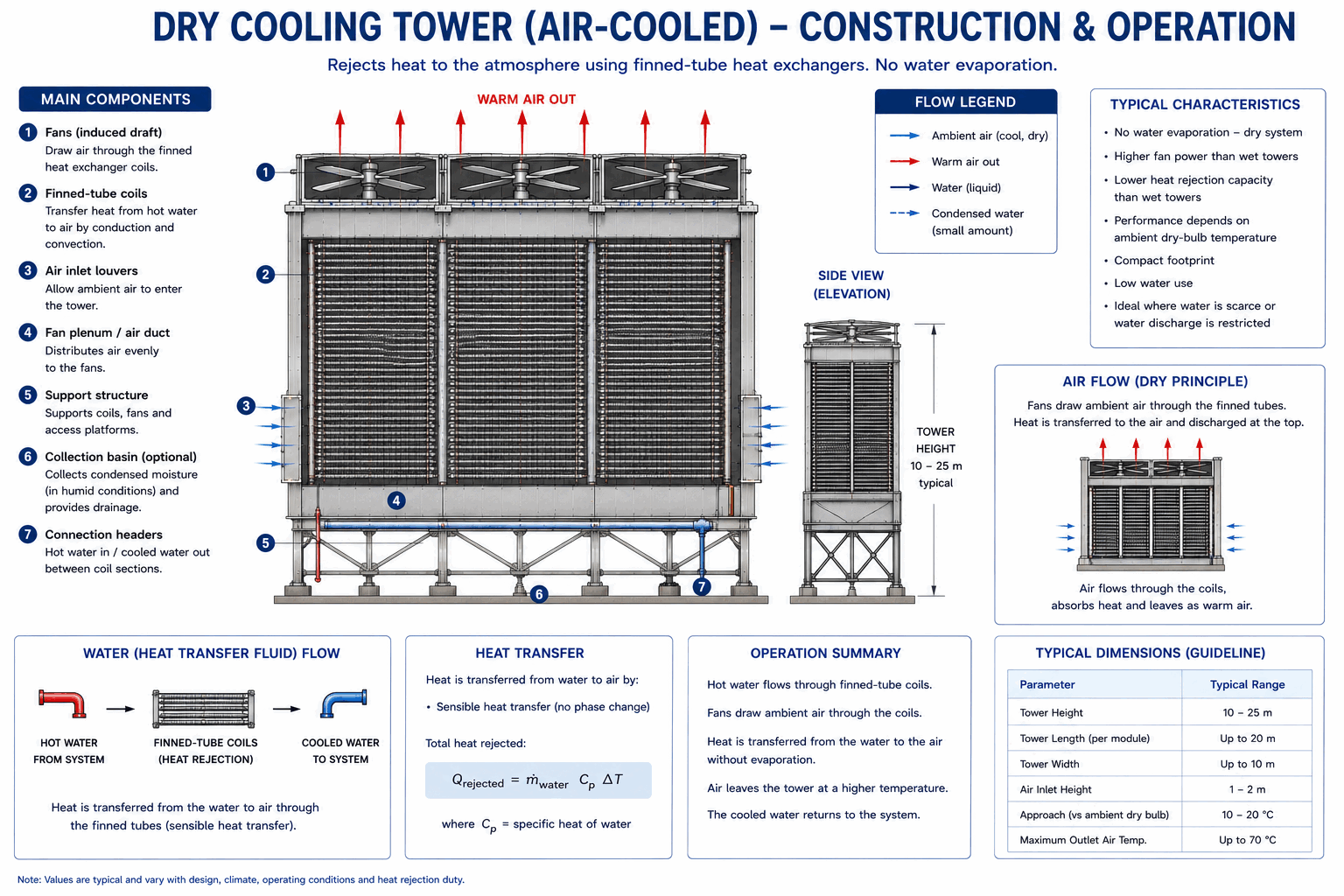
Dry air-cooled cooling tower construction and operation: labelled main components, finned-tube coils, induced-draft air flow, side elevation, typical dimensions, and sensible heat transfer summary.

click to enlarge

Process fluid (steam or hot water) flows through finned tube bundles; large axial fans below push ambient air across the fins. No water leaves the system as vapour — heat transfer is sensible only.

How It Works

A dry cooling tower — in its most direct form, an air-cooled condenser (ACC) — rejects heat to the atmosphere with no water ever contacting the air at all. Hot process fluid, most commonly steam exhausting directly from a turbine in a direct ACC, or hot water in an indirect dry-cooled system, flows through an extensive array of finned tube bundles, and large-diameter axial fans mounted beneath the bundles (or, in some designs, arranged around them) push ambient air across the fins.

This is pure sensible heat transfer — there is no latent heat contribution at all, because there is no evaporation. That single fact is the source of both the technology's greatest advantage and its most significant limitation. Air has a far lower heat capacity and a far lower heat transfer coefficient than water in contact with evaporating film, so an air-cooled system needs a dramatically larger heat transfer surface area — hence the extensive fins, which multiply the effective surface area in contact with the air many times over — and dramatically more air mass flow, to move the same quantity of heat that a wet tower moves with a fraction of the airflow.

Because there is no evaporation, dry cooling performance is governed entirely by dry bulb temperature, not the much lower wet bulb temperature a wet tower can approach. On a hot, dry day — precisely the day a wet tower performs best, since low humidity keeps wet bulb well below dry bulb — a dry cooling system faces its worst-case driving force, since dry bulb itself is at its highest. This is the defining performance trade-off of dry cooling: the technology that uses no water performs worst exactly when cooling is needed most, on the hottest days of the year.

Direct air-cooled condensers, common on modern power plants sited in water-scarce regions, typically arrange the finned bundles in an A-frame or delta configuration directly above a steam duct from the turbine, condensing steam directly inside the finned tubes with the condensate draining by gravity. Indirect dry cooling instead uses a closed water loop between the process (often a conventional surface condenser) and a separate dry air-cooled heat exchanger — mechanically more complex, with an extra heat exchange step, but decoupling the turbine exhaust duct routing from the cooling equipment layout.
Advantages & Disadvantages

Advantages

  • Zero water consumption. The only cooling technology that uses no water at all — no evaporation, no drift, no blowdown, no makeup water requirement whatsoever.
  • No visible plume, ever. With no evaporation there is no moisture to condense back out of the exhaust air — dry cooling is inherently plume-free under any weather condition.
  • No water treatment or blowdown chemistry to manage. Eliminates the entire water-side chemical treatment programme a wet tower requires — no scale inhibitors, no biocides, no cycles-of-concentration balancing.
  • No risk of waterborne biological growth such as Legionella, since there is no recirculating water spray exposed to the atmosphere at all.
  • Enables siting in water-scarce locations where no other cooling technology, wet or hybrid, would be viable.

Disadvantages

  • Much larger physical size for the same duty. Air's poor heat transfer coefficient demands dramatically more surface area and footprint than any wet alternative.
  • Highest capital cost per unit of heat rejected of any common configuration, driven directly by that surface area requirement.
  • Substantially higher fan power. Moving the much larger air volume required for sensible-only heat transfer costs significantly more electricity than a wet tower's fans.
  • Severe hot-weather performance penalty. Because performance tracks dry bulb rather than the much lower wet bulb, hot days — exactly when cooling demand peaks — are this technology's worst-case operating condition.
  • Real cold-weather risks of its own. Air-side freezing of condensate or coil sections in extreme cold is a genuine design and operating consideration, a completely different failure mode from a wet tower's spray-freezing risk but no less real.
Typical applicationsPower plants and industrial processes in genuinely water-scarce regions — desert and arid-climate sites — or anywhere water rights, discharge permits, or water cost make any water-consuming cooling technology impractical, regardless of the CAPEX and hot-weather performance trade-offs involved.

Compare Cooling Tower Types

Compare withNatural DraftCompare withInduced DraftCompare withForced DraftCompare withHybridCurrently viewingDry / ACC

Want the numbers behind these trade-offs — approach, water consumption, fan power, sizing, and operating cost for your own heat load and weather? Use the Cooling Tower Calculator.