Skip to content

Drawing No. EH–TH–030 // Thermal Engineering & HVAC

Mechanical Induced Draft Cooling Tower

Reviewed August 2026

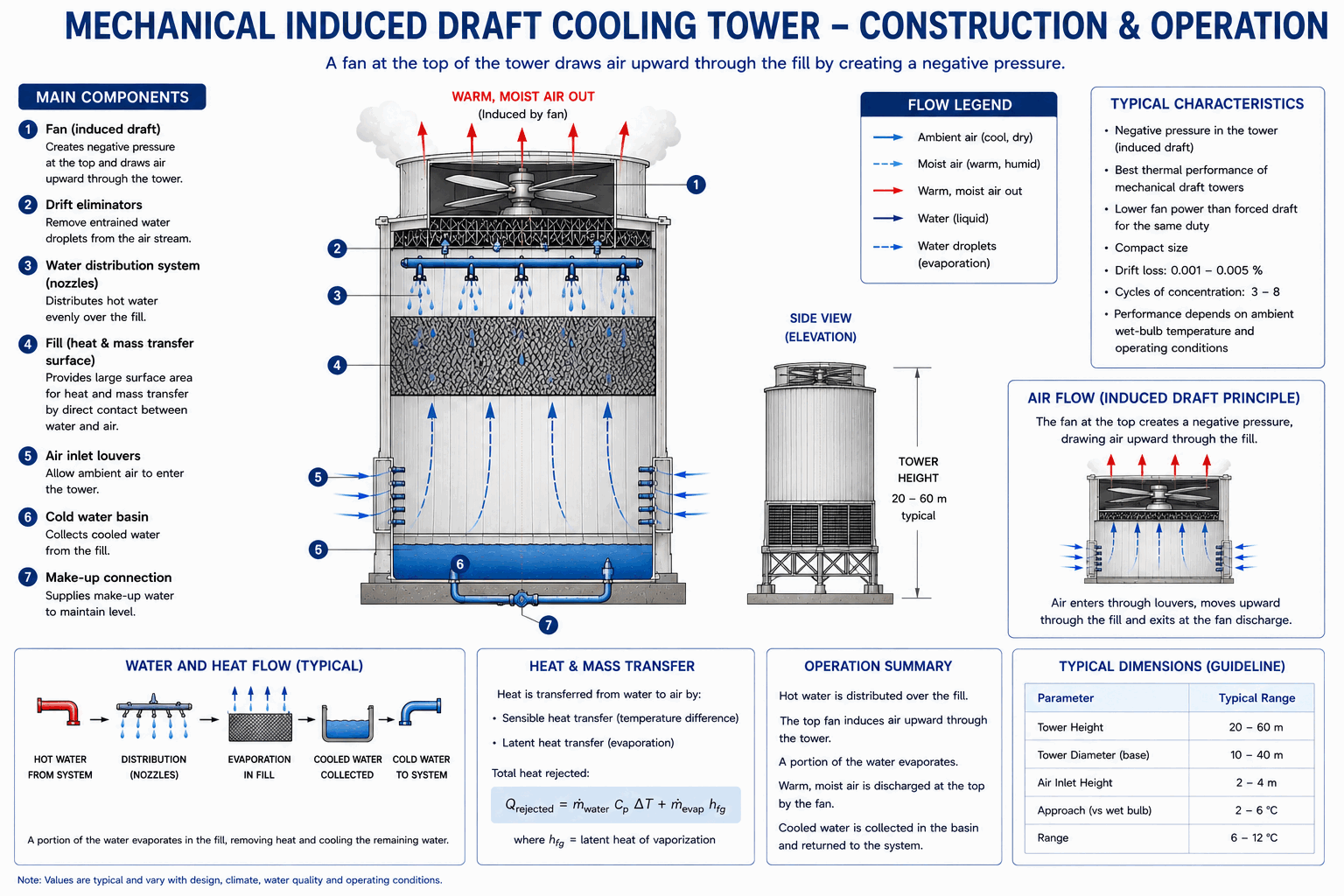
A fan mounted above the fill pulls air upward through the tower, counter to the falling water — the most common cooling tower configuration in industrial and power plant service.

CounterflowFan on topMost common type
Mechanical induced draft cooling tower construction and operation: labelled main components, induced-draft air flow under negative pressure, side elevation, typical dimensions, and heat and mass transfer summary.

click to enlarge

The fan draws air in through louvers at the base and up through the fill counter to the falling water, discharging warm, saturated air above the fan deck.

How It Works

An induced draft tower uses one or more axial fans mounted on a deck above the fill to actively pull air through the tower, rather than relying on buoyancy alone. Air enters through louvers around the base, travels upward through the fill in direct counterflow to the falling water — water moving down, air moving up, meeting head-on — and is discharged well above the fill by the fan, which both reduces the chance of the humid exhaust being drawn straight back into the air inlets (recirculation) and gives the plume enough exit velocity to disperse away from the structure.

Counterflow contact is thermodynamically the most favourable geometry available: at every point in the fill, the air meeting the coldest water is itself the coldest, driest air just entering, and the air meeting the hottest water at the top is already the warmest, most humid air about to leave. That arrangement maximises the average driving force between water and air across the full height of the fill compared with a crossflow arrangement, which is the physical reason induced draft counterflow towers can achieve a tighter approach for a given fill volume than a comparable crossflow design.

Because a fan actively sets the airflow, the water-to-air mass flow ratio (L/G) — the single parameter that most determines a tower's thermal characteristic — becomes a genuine design and operating choice rather than something fixed by the structure's geometry alone. Variable-speed or multi-speed fans let the tower track a varying heat load or ambient condition directly, trading fan electricity for approach in a way a natural draft tower simply cannot.

The fan and its motor sit directly in the warm, saturated exhaust air stream leaving the tower — the defining maintenance trade-off of this configuration. That environment is corrosive and humid, so induced draft fan motors, drive shafts, and gearboxes need to be specified for continuous duty in a wet, warm atmosphere, and routine maintenance means working at height inside that same exhaust stream.
Advantages & Disadvantages

Advantages

  • Best thermal performance per unit of fill volume. True counterflow contact gives the most favourable driving force of any common configuration, for a compact footprint.
  • Airflow is a controllable design variable. Fan speed can be adjusted to match load or weather, something no buoyancy-driven tower offers.
  • Compact relative to capacity. Multiple cells can be arranged in a row to reach almost any duty, from small process coolers to large multi-cell power plant installations.
  • Mature, widely available equipment. Induced draft cells are effectively an industrial commodity, with well-established fan, fill, and drift eliminator technology from many manufacturers.
  • Good exhaust dispersion. Discharging above the fan deck, well clear of the air inlets, minimises the risk of the tower recirculating its own warm exhaust back into its intake.

Disadvantages

  • Fan power is a real, continuous parasitic cost. Unlike natural draft, this tower spends electricity every hour it runs, and that cost scales with roughly the cube of fan speed.
  • Fan and motor live in the harshest possible environment. Continuous exposure to warm, saturated, sometimes chemically treated exhaust air shortens component life and complicates maintenance access, which typically means working at height inside the exhaust stream itself.
  • More failure modes than natural draft. Fan blades, bearings, drive shafts, and gearboxes are all additional equipment that can fail, requiring a maintenance programme a fan-free tower does not need.
  • Audible fan noise. Even with modern low-noise fan designs, induced draft towers are meaningfully louder than natural draft towers of comparable duty.
  • Vulnerable to plume recirculation in adverse wind. Under some wind conditions, exhaust from one cell can be drawn into a neighbouring cell's intake, degrading performance across a multi-cell bank.
Typical applicationsThe default choice across most of industry — power plant condenser cooling at small to mid scale, refineries, chemical plants, HVAC and chiller plant cooling — anywhere a compact footprint and controllable performance matter more than the fan-free operation of natural draft.

Compare Cooling Tower Types

Compare withNatural DraftCurrently viewingInduced DraftCompare withForced DraftCompare withHybridCompare withDry / ACC

Want the numbers behind these trade-offs — approach, water consumption, fan power, sizing, and operating cost for your own heat load and weather? Use the Cooling Tower Calculator.