Skip to content

Drawing No. EH–TH–025 // Thermal Engineering & HVAC

Hybrid (Wet/Dry) Cooling Tower

Reviewed August 2026

A wet evaporative section and a dry finned-coil section operating side by side, with their air streams blended before discharge — built specifically to cut water use and suppress the visible plume.

Wet + dry sectionsPlume abatementWater saving
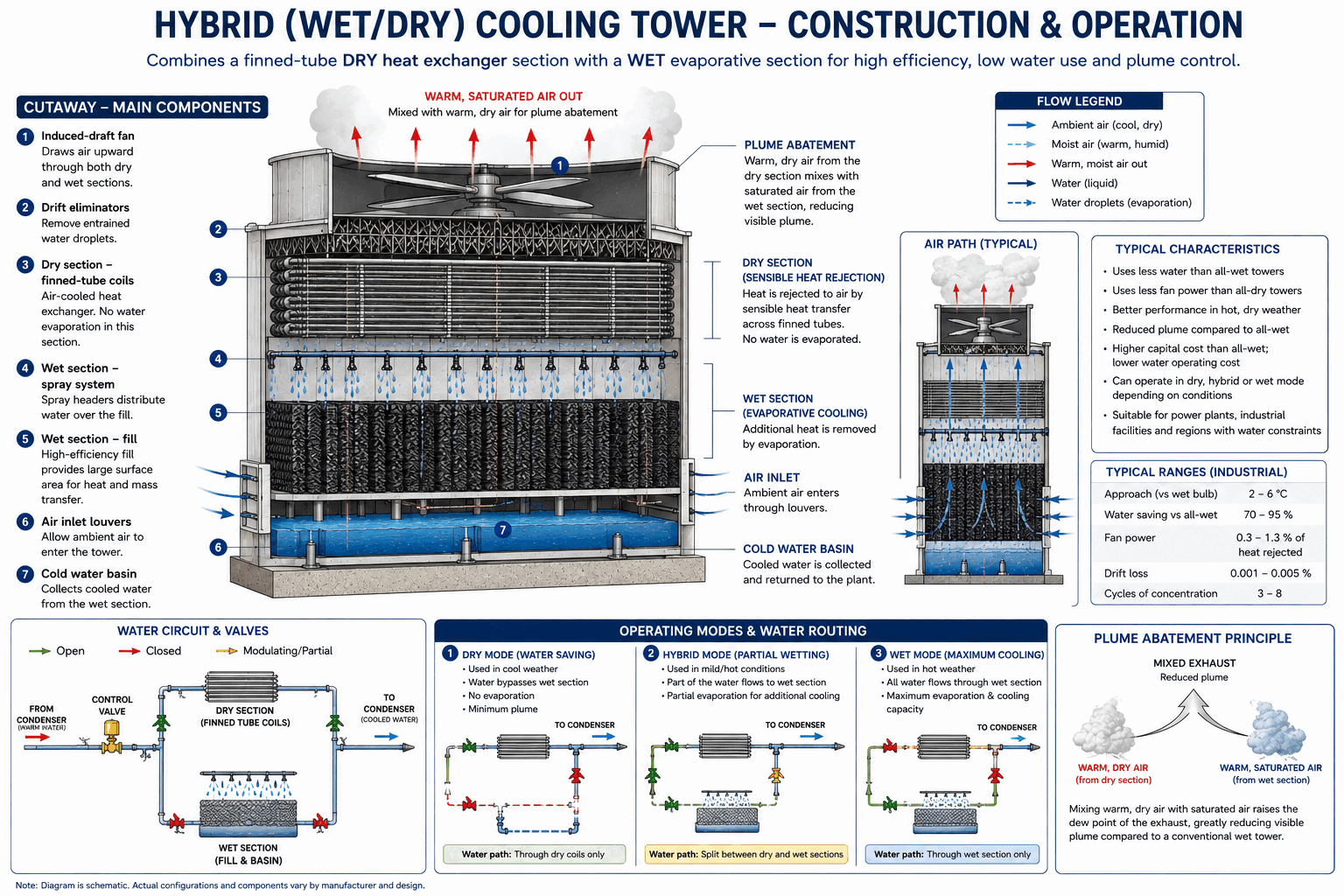
Hybrid wet/dry cooling tower construction and operation: labelled main components, dry finned-tube and wet evaporative sections, operating modes and water routing, plume abatement principle, and typical performance ranges.

click to enlarge

Warm, saturated air from the wet section blends with warm, dry air from the finned coil section before discharge — the mixed stream sits below saturation, which is what suppresses the visible plume.

How It Works

A hybrid tower runs two genuinely different heat rejection mechanisms in parallel within a single structure: a conventional wet section, cooling water by evaporation across a fill pack exactly as a mechanical draft tower does, and a dry section, cooling water (or a separate stream) by sensible heat transfer alone across finned tube bundles, with no water contact with the air at all. Both sections typically share the structure and, critically, their discharge air streams are combined in a common plenum before exiting through the fan or fans.

The wet section carries most of the actual cooling duty — evaporation is a far more effective heat rejection mechanism per unit of airflow than sensible transfer alone, so the dry section on its own would need to be enormous to match it. The dry section's job is not really to do the bulk of the cooling; it is to condition the air stream that eventually leaves the tower.

That conditioning is the entire point of the design: air leaving the wet section is warm and close to saturated with moisture, which is exactly the state that produces a visible plume when it mixes with cooler ambient air and condenses back into droplets. Air leaving the dry section is warm but essentially bone dry. Blending the two before discharge produces a mixed air stream that sits below saturation on a psychrometric chart even though it is still warm — there is no excess moisture left to condense out, so no visible plume forms. This is plume abatement, and it is achievable in no other tower configuration without adding a dedicated dry section.

Because the wet and dry sections can often be controlled somewhat independently — separate dampers, separate fan speeds, or in some designs entirely separate airflow paths — a hybrid tower can shift its balance seasonally: leaning harder on the dry section in cold weather, when plume risk is highest and dry-section performance is at its best, and leaning on the wet section in hot weather, when evaporative cooling's advantage over sensible cooling is greatest and plume risk is naturally lower anyway.
Advantages & Disadvantages

Advantages

  • Genuinely reduced water consumption. Diverting a portion of the duty to the dry section directly cuts evaporation, drift, and blowdown compared with an all-wet tower of the same capacity.
  • Plume abatement. The defining capability of this configuration — blending dry and saturated air streams suppresses the visible plume that a pure wet tower cannot avoid, valuable near airports, highways, or visually sensitive sites.
  • Operational flexibility. The wet/dry balance can be shifted with the seasons or with water availability, something neither a pure wet nor a pure dry tower can do.
  • Can satisfy environmental permits that a conventional wet tower's water use or plume would not meet, without accepting the full footprint and cost penalty of an all-dry design.
  • Retains most of a wet tower's thermal performance, since the wet section still carries the bulk of the duty rather than being replaced outright.

Disadvantages

  • Highest capital cost of any configuration. This is genuinely two heat rejection systems built as one, with the equipment cost of both.
  • More complex controls. Balancing wet and dry sections, managing dampers or independent fans, and coordinating their combined discharge adds a layer of control-system complexity a single-mode tower does not have.
  • More equipment, more maintenance. Fill, spray systems, and drift eliminators from the wet side plus finned coils and their own fans from the dry side means more components that can individually need attention.
  • Larger footprint than a pure wet tower of the same duty, since the dry section occupies additional structure and air-path volume.
  • Still consumes some water. A hybrid tower is a genuine reduction versus an all-wet design, not an elimination — sites needing zero water consumption still need a fully dry solution.
Typical applicationsSites where plume visibility is a real permitting or community concern — near airports, over highways, or in urban and visually sensitive settings — and sites balancing water conservation goals against the cost and performance penalty of going fully dry.

Compare Cooling Tower Types

Compare withNatural DraftCompare withInduced DraftCompare withForced DraftCurrently viewingHybridCompare withDry / ACC

Want the numbers behind these trade-offs — approach, water consumption, fan power, sizing, and operating cost for your own heat load and weather? Use the Cooling Tower Calculator.