Index/
Cooling Tower Calculator/
Natural Draft Cooling Tower
Drawing No. EH–TH–031 // Thermal Engineering & HVAC
Natural Draft Cooling Tower
Reviewed August 2026
A hyperbolic concrete shell that moves air purely by buoyancy — no fans, no motors, just the density difference between the warm, moist air inside the tower and the cooler air outside.
No fansBuoyancy-drivenLarge scale
How It Works
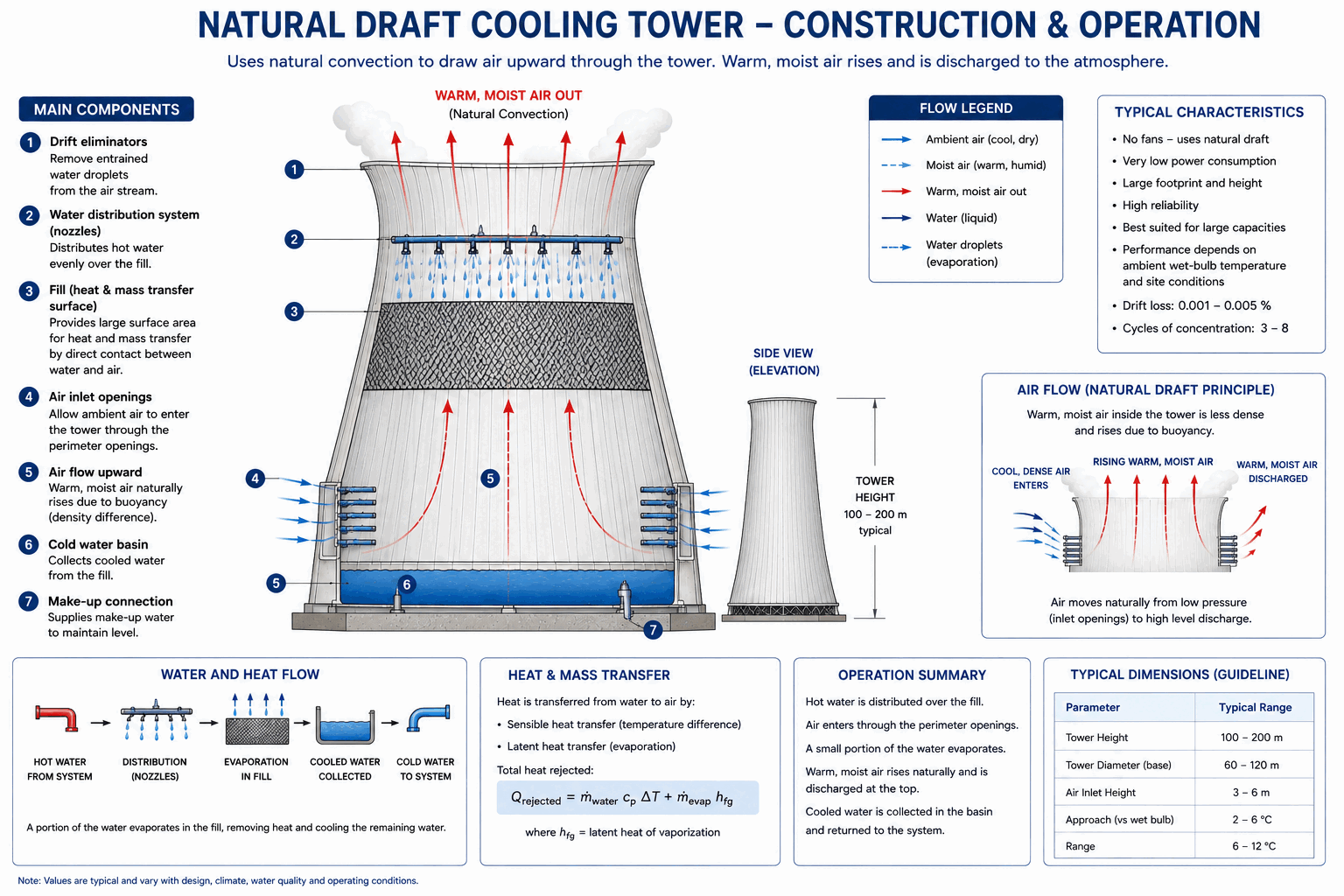
A natural draft tower works on exactly the same evaporative heat and mass transfer principle as every wet cooling tower: hot water is broken into a large surface area of thin films or droplets across a fill pack, and air is drawn through that fill in intimate contact with the water. What makes natural draft distinctive is how the air gets moving at all — there is no fan anywhere in the system. Air enters through louvered openings around the base of the shell, picks up heat and moisture as it passes up through the fill, and becomes measurably less dense than the surrounding atmosphere. That density difference, acting over the full height of the shell, is the entire driving force: the tower is, in effect, a very large, very slow chimney.
The hyperbolic shape of the shell is not decorative. A hyperboloid of revolution is structurally efficient in thin-shell reinforced concrete — it can be built with a wall only 150–300 mm thick despite the shell often standing 100–200 m tall — and its narrowing throat above the fill accelerates the rising air column, reinforcing the draft the same way a venturi accelerates flow through a constriction. The flared base similarly smooths and evens out air entry around the full circumference, reducing turbulent losses right where the fill needs the most uniform air distribution.
Water is pumped to a distribution system near the top of the fill — either gravity-fed basins with orifices (common with film fill) or a network of spray branches (more common with splash fill) — and falls through the fill under gravity alone, no pumping energy spent moving it horizontally or against a fan-created pressure drop. Below the fill, drift eliminators strip out any entrained liquid droplets before the air exits, and the cooled water collects in a basin at the base for return to the process.
Because there is no fan to boost airflow, the tower's capacity is fixed by its geometry (height, base diameter, throat diameter) and by ambient conditions on any given day — draft strength genuinely depends on how much warmer the internal air is than the atmosphere outside, which is itself a function of wet bulb temperature and the tower's own thermal loading. This is why natural draft towers are built tall: height is the one lever available to increase draft without adding any mechanical equipment at all.